
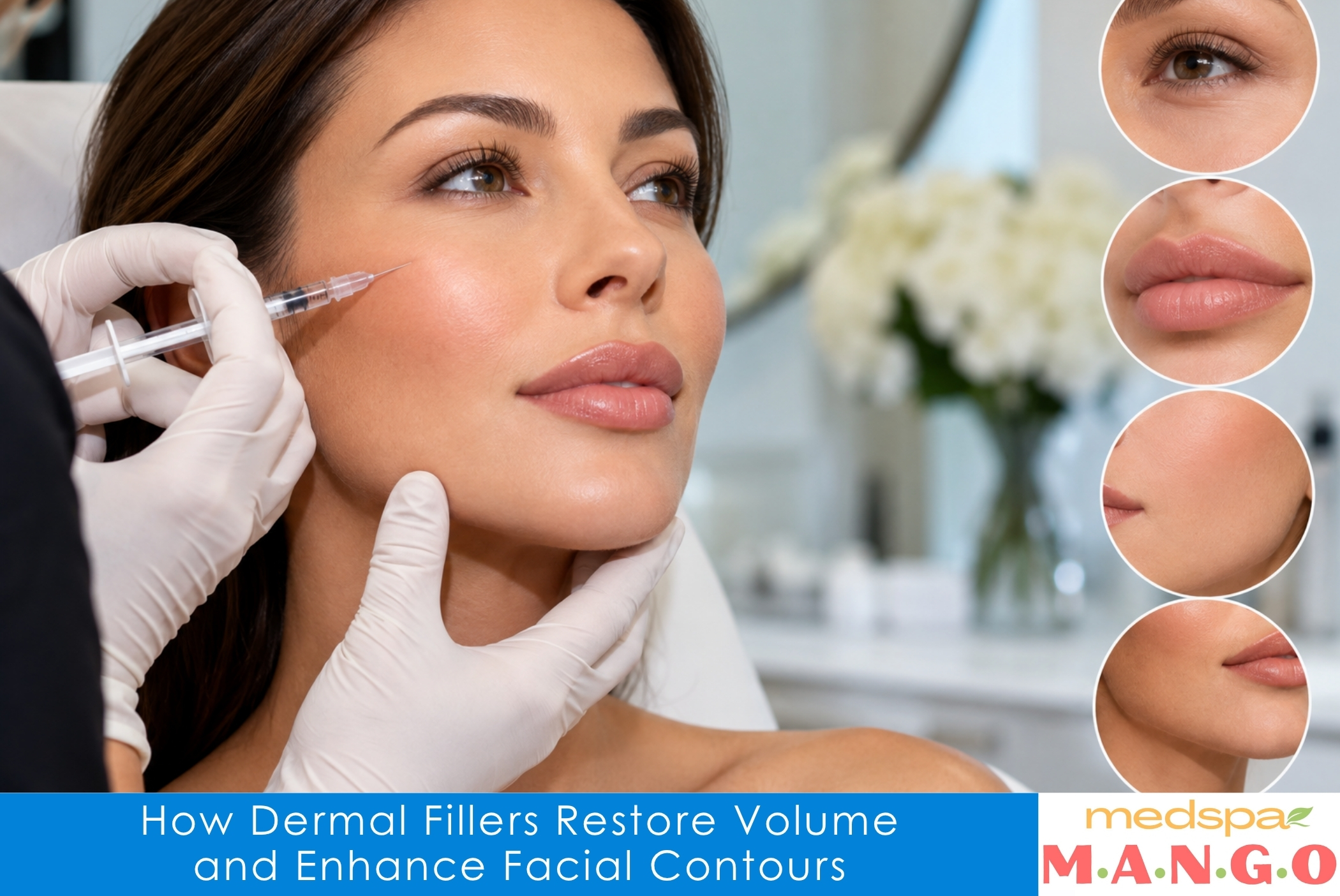
Facial aging is about more than wrinkles. Over time, changes in skin elasticity, facial fat, bone structure, and soft-tissue support can alter the proportions and contours that give the face its youthful definition. Cheeks may appear flatter, folds around the mouth may become more noticeable, lips can lose fullness, and the jawline or chin may look less defined.
Dermal fillers offer a nonsurgical approach to addressing many of these changes. By strategically adding volume beneath the skin, fillers can restore fullness, soften certain lines and folds, enhance facial contours, and create more balanced proportions. The U.S. Food and Drug Administration (FDA) has approved specific dermal fillers for uses that include increasing fullness in areas such as the cheeks, chin, lips, under-eye hollows, and jawline, depending on the individual product and its approved indication.
At Medspa MANGO in Scottsdale, Arizona, dermal filler treatment can be customized around each patient’s facial anatomy, aesthetic goals, and desired degree of enhancement. Rather than simply focusing on individual wrinkles, a thoughtful filler plan considers the face as a whole and aims to preserve natural expression while improving balance and definition.
What Are Dermal Fillers?
Dermal fillers are injectable medical devices designed to create a smoother or fuller appearance in specific areas of the face and, for certain products, the hands. They are placed beneath the skin or within targeted tissue planes to add volume, improve contour, or soften particular facial lines.
Different fillers have different compositions, characteristics, approved indications, and expected durations. Common temporary filler materials include hyaluronic acid, calcium hydroxylapatite, and poly-L-lactic acid. The appropriate product depends on the treatment area, facial anatomy, desired result, and the product’s FDA-approved indication.
Hyaluronic Acid Fillers
Hyaluronic acid, often abbreviated HA, is a substance naturally present in tissues throughout the body. In gel form, it can bind with water and provide a filling and smoothing effect. HA-based fillers are widely used for facial augmentation and correction, although individual products differ in their approved uses and physical properties.
Some formulations may be better suited to providing structural support, while others may be selected when softer, more flexible enhancement is desired.
Other Types of Dermal Fillers
Dermal fillers are not limited to hyaluronic acid. Calcium hydroxylapatite and poly-L-lactic acid are among other absorbable materials used in FDA-approved filler products. Because these materials behave differently within tissue, choosing a filler should be based on professional assessment rather than selecting a product simply because it is popular.
Why Does the Face Lose Volume With Age?
One of the most important concepts in modern facial rejuvenation is that aging affects the entire facial structure.
The American Society of Plastic Surgeons notes that facial aging involves loss of subcutaneous fat as well as other changes influenced by factors such as sun exposure, heredity, and lifestyle. As facial fullness decreases, muscles may lie closer to the skin surface, making certain lines and folds more noticeable.
Changes in Facial Fat
Youthful faces typically have strategically distributed fat that contributes to smooth transitions between the cheeks, temples, eyes, and lower face.
As facial fat compartments change with age, the cheeks can become less prominent and shadows or folds may become more apparent.
Changes in Bone and Structural Support
Facial aging also involves deeper structural changes. The framework supporting the soft tissues changes over time, which can contribute to alterations in facial proportions and definition.
This is one reason modern filler treatment often involves more than filling an isolated wrinkle. Restoring appropriate support in carefully selected areas can sometimes improve the overall contour of the face.
Changes in Skin
Collagen, elastin, hydration, environmental exposure, and other biological factors influence how the skin changes over time. When skin changes occur alongside volume loss, wrinkles and folds can become more pronounced.
Dermal fillers do not stop the biological aging process, but they can help address specific volume and contour concerns.
How Dermal Fillers Restore Facial Volume
Dermal fillers work by adding carefully controlled amounts of material beneath the skin in strategically selected locations.
The goal is not necessarily to make the face look larger or dramatically different. In many cases, treatment focuses on replacing volume where it has diminished or enhancing an area that naturally lacks projection.
Restoring Cheek Volume
The cheeks play an important role in overall facial shape.
Loss of midface volume may cause the cheeks to appear flatter and can change the transition between the lower eyelid and cheek. Strategic cheek augmentation can restore projection and create a smoother, more balanced facial contour.
The FDA has approved certain dermal fillers specifically for cheek augmentation in adults, although the exact indication depends on the product.
Improving Chin Projection
The chin influences both the front and profile views of the face. A chin that lacks projection may affect the perceived balance between the nose, lips, jawline, and lower face.
Certain FDA-approved fillers can be used for chin augmentation, allowing qualified injectors to improve projection and contour without surgery.
Enhancing the Jawline
Jawline definition can be affected by genetics, aging, changes in facial volume, skin laxity, and underlying anatomy.
Selected dermal fillers have FDA-approved indications for jawline enhancement. When appropriate, carefully planned treatment may improve definition and create a stronger transition between the face and neck.
Restoring Lip Volume and Shape
Lips naturally vary considerably in size and shape. Aging can also contribute to reduced lip volume and changes around the mouth.
Dermal fillers can be used to increase lip fullness, refine proportions, and enhance contours. A conservative approach can help preserve natural movement and avoid an overfilled appearance.
Softening Nasolabial Folds and Other Facial Creases
Nasolabial folds extend from the sides of the nose toward the corners of the mouth. These folds may become more prominent as facial anatomy and volume distribution change.
Temporary dermal fillers are FDA-approved for certain moderate-to-severe facial wrinkles and folds, including nasolabial folds.
Depending on the individual, treatment may involve directly addressing the fold, restoring support elsewhere in the face, or combining approaches.
Dermal Fillers and Facial Contouring
Facial contouring is different from simply filling wrinkles.
A comprehensive approach considers the relationships among facial features. Small changes in one area can influence how another area is perceived.
Creating Better Facial Proportions
For example, enhancing chin projection may improve the balance of the facial profile. Restoring cheek volume may create more definition through the midface. Subtle lip enhancement can improve the relationship between the lips and surrounding facial features.
The objective is individualized proportion—not an identical facial shape for every patient.
Supporting Natural-Looking Results
Natural-looking filler treatment typically requires restraint and careful planning.
More filler does not automatically produce a better result. Appropriate product selection, placement, depth, volume, and knowledge of facial anatomy are all important.
The FDA specifically recommends receiving fillers from a licensed healthcare provider who is appropriately trained and experienced in dermal filler injections.
Which Areas Can Dermal Fillers Treat?
Depending on the specific FDA-approved product and indication, dermal fillers may be used to address areas including:
- Cheeks and midface
- Chin
- Jawline
- Lips
- Nasolabial folds
- Certain facial wrinkles and folds
- Under-eye hollows with appropriately approved products
- Certain acne scars
- Back of the hands
Not every filler is approved for every area. FDA approval is product- and indication-specific, making professional product selection important.
What Makes a Good Candidate for Dermal Fillers?
Dermal filler candidacy should be determined during an individual consultation.
You Want Nonsurgical Facial Enhancement
Fillers may appeal to patients who want to improve facial contours or volume without undergoing cosmetic surgery.
However, fillers and surgery accomplish different things. Injectable fillers cannot reproduce all of the changes achievable with procedures such as a facelift.
You Have Realistic Expectations
Dermal fillers are best approached as tools for enhancement rather than complete transformation.
Patients should discuss what bothers them, what they hope to change, and how noticeable they want their results to be.
Your Medical History Is Appropriate for Treatment
Certain medical conditions, allergies, medications, infections, and other factors can affect filler candidacy.
The FDA advises patients to tell their healthcare provider about active skin inflammation or infection, bleeding disorders, severe allergies, previous anaphylaxis, and allergies to ingredients that may be contained in specific filler formulations.
What Happens During a Dermal Filler Consultation?
A successful filler treatment begins before the injection itself.
Facial Assessment
Your provider may evaluate facial symmetry, proportions, volume distribution, skin characteristics, and the relationship among different facial features.
Your face should be evaluated both at rest and during expression because movement can affect treatment planning.
Discussing Your Goals
Some patients want noticeable contour enhancement, while others want changes that are extremely subtle.
Clearly communicating your preferences helps your provider develop an individualized treatment plan.
Selecting the Appropriate Filler
Fillers differ in composition and approved uses. Product selection should therefore be based on the treatment area’s needs and the manufacturer’s approved indications rather than taking a one-product-fits-all approach.
What to Expect During Treatment
Dermal filler appointments are generally performed without surgery.
The treatment area is evaluated and prepared, and filler is injected using an appropriate needle or cannula depending on the product and treatment plan. Some filler formulations contain lidocaine to help reduce discomfort associated with injection.
Treatment time varies according to the number and complexity of areas being addressed.
When Will You See Dermal Filler Results?
Many fillers create visible volume immediately after placement, although swelling can temporarily influence how the treated area looks.
The final appearance should be assessed after early swelling and bruising have had time to resolve.
Some filler materials and treatment approaches may behave differently, so patients should discuss the expected timeline for their particular product with their provider.
How Long Do Dermal Fillers Last?
Dermal fillers are generally not permanent.
Duration depends on the filler material, specific product, injection location, amount used, individual anatomy, and other factors. The FDA notes that many fillers are naturally absorbed over time and treatment may eventually need to be repeated to maintain the desired effect.
For example, the FDA describes hyaluronic acid filler effects as approximately 6–12 months in general, while calcium hydroxylapatite may last approximately 18 months; individual products, treatment areas, and patients vary.
Rather than assuming a particular result will last a predetermined number of months, ask your provider what to expect from the specific filler recommended for you.
Dermal Fillers vs. Botox: What Is the Difference?
Dermal fillers and botulinum toxin products are both injectable aesthetic treatments, but they work differently.
Dermal Fillers Add or Restore Volume
Fillers are placed beneath the skin to provide fullness, structural enhancement, or smoothing in appropriately selected areas.
Neuromodulators Affect Muscle Activity
Botulinum toxin products work by temporarily reducing targeted muscle contraction. They are commonly used for certain expression-related facial lines.
The FDA emphasizes that botulinum toxin products are injectable drugs and are not dermal fillers.
Which approach is appropriate depends on what is causing the aesthetic concern.
Are Dermal Fillers Safe?
FDA-approved dermal fillers have been evaluated for specific indications, but filler injection is a medical procedure and carries risks.
Common reactions can include bruising, redness, swelling, pain, tenderness, itching, and rash. Less common complications include infection, nodules, allergic reactions, open wounds, and tissue damage.
Understanding Vascular Complications
One of the most serious potential complications is accidental injection of filler into a blood vessel.
Although uncommon, vascular occlusion can interrupt blood flow and potentially result in tissue necrosis, visual abnormalities including blindness, or stroke.
This risk underscores why filler injections should be performed by appropriately trained, licensed healthcare professionals who understand facial anatomy, product characteristics, and complication management.
Patients should seek immediate medical attention for symptoms such as unusual or severe pain, vision changes, skin that becomes white, gray, or blue near an injection site, or symptoms suggesting a stroke during or shortly after treatment.
How to Prepare for Dermal Filler Treatment
Preparation should always follow your provider’s individualized instructions.
Review Your Medical History
Tell your provider about medications, supplements, allergies, previous cosmetic procedures, medical conditions, and any previous reactions to injectable treatments.
Discuss Recent Skin Problems
Active infections, rashes, cysts, pimples, or other inflammatory skin conditions in the treatment area may require postponing treatment until the problem has resolved.
Plan Around Important Events
Because swelling and bruising can occur, consider allowing adequate time between your filler appointment and major photographs, weddings, vacations, or other important events.
What Is Recovery Like After Dermal Fillers?
Recovery varies by treatment area, filler, amount injected, and individual response.
Temporary swelling, tenderness, redness, and bruising are among the most common reactions. The FDA reports that many filler-related reactions occur shortly after injection and resolve within days to weeks.
Follow the specific aftercare instructions provided by your injector and contact the practice promptly if you experience unexpected symptoms.
Why Personalized Dermal Filler Treatment Matters
Every face has different proportions, bone structure, soft-tissue distribution, and patterns of aging.
For this reason, filler treatment should not be based solely on trends or standardized amounts.
Treat the Face, Not Just the Wrinkle
A prominent fold or shadow does not always mean that area simply needs to be filled.
A comprehensive assessment can identify whether volume loss, structural support, skin quality, facial movement, or a combination of factors is contributing to the concern.
Start Conservatively
Subtle enhancement can often produce meaningful improvements in facial balance.
Additional treatment can be considered when appropriate, while excessive volume can distort natural facial proportions.
Maintain Your Individual Features
Successful facial contouring should complement the characteristics that make your face unique. The goal may be to look refreshed, more balanced, or better defined while still looking recognizably like yourself.
Frequently Asked Questions About Dermal Fillers
Do dermal fillers make your face look bigger?
Not necessarily. Strategic filler placement can restore lost volume or improve specific proportions without making the entire face appear larger. The outcome depends on the areas treated, amount used, product selected, and individual anatomy.
Can fillers make me look younger?
Fillers can address certain age-related changes such as facial volume loss, folds, and reduced contour definition. They do not stop aging or address every component of facial aging, but they may create a refreshed appearance in appropriately selected patients.
What is the best age to start dermal fillers?
There is no universal “best” age. Treatment should be based on anatomy, concerns, goals, medical suitability, and approved product indications rather than age alone. FDA-approved dermal filler indications generally apply to adults age 22 and older.
Can dermal fillers improve cheekbones?
Certain fillers can increase cheek volume and projection, which may enhance the appearance of the cheek contour. Product choice and placement should be individualized.
Can filler define my jawline?
Certain FDA-approved filler products have indications for improving jawline definition. Whether filler is appropriate depends on the cause of the concern and your individual anatomy.
Can filler improve a weak chin?
Certain dermal fillers are FDA-approved for chin augmentation. Increasing chin projection may improve lower-face and profile balance in appropriately selected patients.
Will lip filler always look obvious?
No. Lip filler can range from subtle restoration to more noticeable augmentation. Conservative treatment focused on proportions, border definition, and balanced volume can create understated results.
Are filler results permanent?
Most FDA-approved dermal fillers are temporary because their materials are gradually absorbed by the body. Duration varies considerably according to the product and treatment area.
Can dermal fillers be reversed?
Some hyaluronic acid fillers may be reduced using an enzyme when clinically appropriate, but not all fillers can be easily removed. The FDA notes that removing or reducing some filler materials can be difficult or impossible and may require additional procedures.
Is there downtime after dermal fillers?
Many patients can return to normal routines relatively quickly, but swelling, bruising, tenderness, and redness can occur. Your provider will give you instructions based on your treatment.
How much filler will I need?
There is no standard amount that is appropriate for everyone. The amount depends on facial anatomy, treatment area, degree of volume loss, desired result, and the characteristics of the selected product.
Can I treat several areas during one appointment?
Multiple areas may sometimes be incorporated into a comprehensive treatment plan, but the appropriate approach depends on your health, anatomy, goals, products being considered, and your provider’s clinical assessment.
How do I avoid looking overfilled?
Choose a qualified provider who prioritizes facial proportions and conservative, individualized treatment. Starting with an appropriate amount and reassessing before adding more can help preserve natural facial characteristics.
How do I choose a dermal filler provider?
The FDA recommends choosing a licensed healthcare provider who is trained and experienced in dermal filler injections and understands facial anatomy, filler products, risks, and complication management.
Restore Balance and Definition With Dermal Fillers at Medspa MANGO
Dermal fillers have evolved beyond simply “filling wrinkles.” When carefully selected and strategically placed, they can restore volume, enhance cheeks, improve chin or jawline definition, refine lip proportions, soften certain folds, and create greater harmony among facial features.
The most successful treatment begins with an individualized assessment. Facial anatomy, age-related changes, skin characteristics, existing proportions, personal preferences, and realistic expectations should all guide the treatment plan.
If you are interested in learning whether dermal fillers are appropriate for your facial rejuvenation or contouring goals, schedule a consultation with Medspa MANGO in Scottsdale, Arizona. A personalized evaluation can help determine which areas may benefit from treatment and which filler approach is best suited to your goals.
Contact Information
Medspa MANGO
23425 N Scottsdale Rd Ste A103
Scottsdale, AZ 85255
Phone: (480) 513-8813
Website: medspamango.com
Book Online